
Early Years Foundation Stage
The Early Years Foundation Stage (EYFS) sets the standards that all early years providers must meet to ensure that children learn and develop well and are kept healthy and safe. It promotes teaching and learning and gives children the broad range of knowledge and skills that provide the right foundation for good future progress through school and life.
We believe every child deserves the best possible start in life and we feel a natural environment enables them to do this. Children’s early life experiences have an effect on their development and we feel that the play based environment we offer lays good foundations for their future.
Communication and Language
Throughout the session the children are encouraged to extend their vocabulary and fluency in speech in many ways such as singing, reciting rhymes, playing circle games, listening to and being told stories and acting out puppet shows. During Ring-time, meal times, general play and activities, the children take part in conversations and discussions on many different subjects, with both staff and children. This enables the children to become confident communicators with a wide vocabulary.
Literacy
Each day both large and small chalk boards are available for mark making. Clip boards with paper, crayons and coloured pencils are also put out each day, so that the children may take them wherever they like to draw pictures and practice their mark making, including during our risk assessment. During Ring-time we listen to the woodland sounds and play “I hear with my little ear”, encouraging the children to recognise the sounds that make up words. Various alphabet jigsaw puzzles are available to aid them in letter recognition. In the woods there are many opportunities for the children to make progress in their mark making and letter recognition by dragging sticks through the mud, finding sticks that look like letters of the alphabet, creating letters from sticks and seeing letters in the trees or clouds. We take identification sheets and books on walks and the children are able to look up the various things they find. Children are helped to understand that written symbols form words and carry meaning through the reading of stories to individuals and small groups. We provide a basket of beautiful books for children to look at, each with a small amount of writing. This gives children an opportunity to become familiar with books, how to handle them with care and to become aware of their use both for reference and as a source of enjoyment. Through these different opportunities we hope to give the children a life long love of books and learning.
Mathematics
Through playing games and singing songs children are given opportunities to become familiar with the sorting, matching, ordering, sequencing and counting activities which form the basis for early maths. Children are assisted in learning and using the vocabulary of maths, identifying objects by shape, position, size, volume, weight and numbers through songs, rhymes and jigsaw puzzles, use of tally books, stick collection, games and conversations during the day. The children learn to count through activities such as laying out plates and cups at snack time and singing songs such as “Five Little Speckled Frogs”. They make simple calculations through songs like “Ten Currant Buns”, play sorting games with conkers, acorns and shells, learn to match numbers and pictures with dominoes and jigsaws and use Russian Dolls to become aware of order and size. They learn about weights through cooking activties, shapes when making biscuits and cutting paper, and height when comparing each other against the height scale.
Physical Development
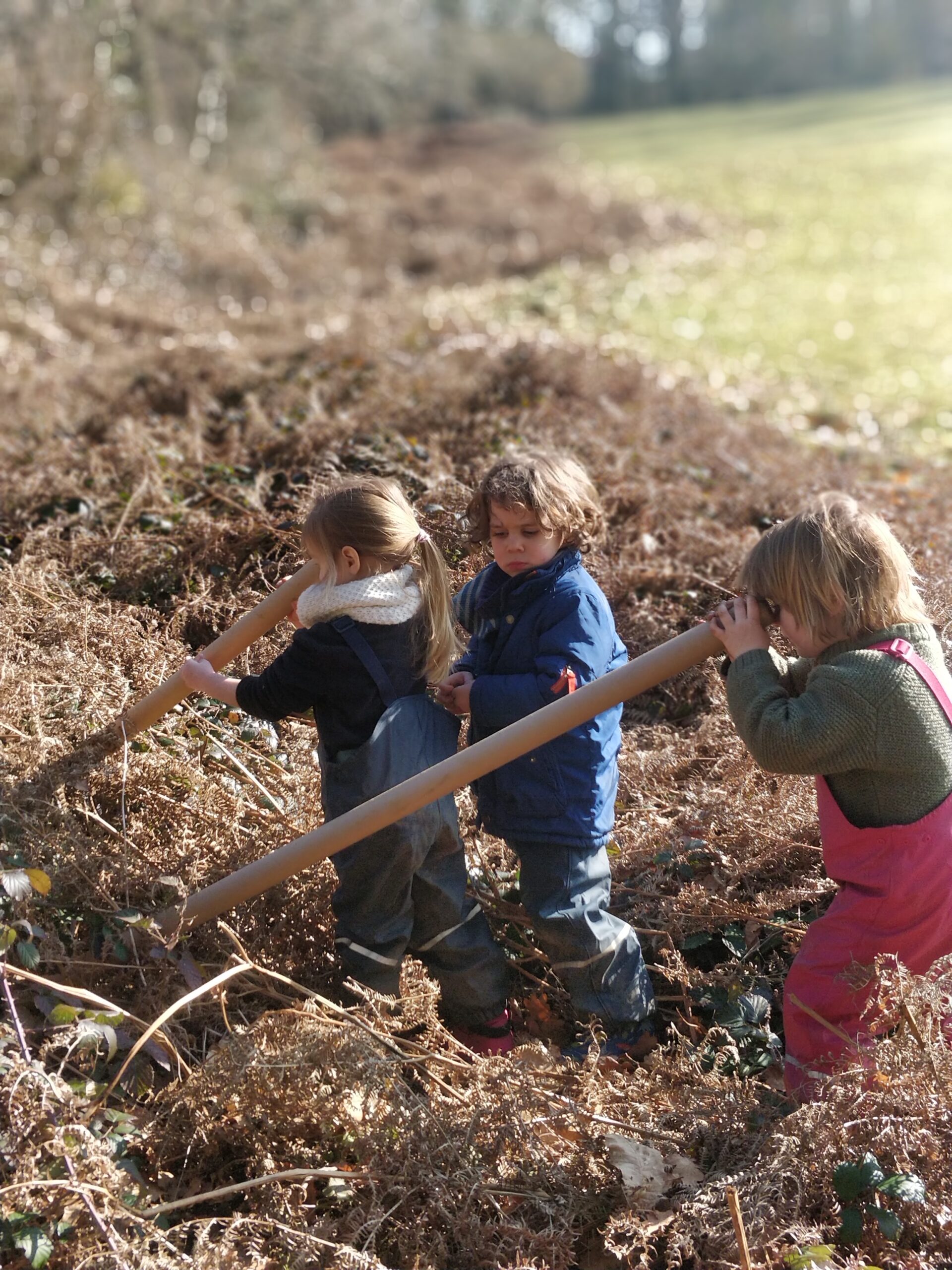
A range of equipment and opportunities allows children to develop confidence and enjoyment in the use and development of their own physical skills such as rocking horses, balancing beams, wood chip pile, mud pit, country walks, gardening, sawing wood, screwing and hammering in nails. With adult supervision children are able to safely create and meet physical challenges, developing skill and control in moving, climbing and balancing. Proprioception skills which allow us to know where our body parts are and how to move them are enhanced when moving around on the uneven surfaces, at different heights and on multiple textures. Music and movement, folk dancing, hopping and jumping games also help them develop these skills. Children are supported in the development of the fine motor skills required to use tools such as pens and pencils and the handling of small objects with control and precision, with the use of finger rhymes, sewing, weaving, bread kneading, sanding wood, finger knitting, painting and drawing, cutting paper with scissors and vegetables with a knife.
Expressive Arts and Design
Children are encouraged to be creative and imaginative in their play including painting, gluing, drawing, modelling, paper cutting, making pictures out of seeds and flowers which provide open-ended exploration of colour, shape and texture. By having natural, simple toys without lots of detail children are given the chance to create for themselves. Building houses, caves and dens from a variety of resources enables them to use their imagination rather than having things ready made for them. We believe that having closed resources with only one outcome can hinder children’s imaginative play, so instead we have open ended loose parts which can be used for anything the children choose. One day a tyre could be a place to hide in and feel safe, but on another could become a giant’s toilet! We encourage childen to be involved in the crafts we offer, usually to celebrate a seasonal festival, but this is ultimately their choice. We are there to guide them through the process of creation, but not to crush their intentions with our own ideals of how something should look or to insist they make a finished product.
Understanding of the World
Children are given the opportinity to explore and understand their environment by being immersed in them on a daily basis. Going for walks in the fields and woods, discovering what grows there at different times of year and noticing the changes, allow us to embrace the seasons fully. In the early autumn we pick blackberries, which can be made into jam, crumbles or used as natural dyes. Festivals from different traditions are celebrated and the children take part in seasonal crafts and activities. We eat a wide range of foods, some of which are prepared by the children using cooking utensils, such as knives and graters. We grow our own vegetables from seed and the childen are involved in the care and harvesting of these, allowing them to understand where their food comes from. Songs and dances from different countries are taught and stories told from other cultures. Sewing and simple woodwork projects, such as making a weaving loom, enable the children to extend their understanding of how things are made and used.
Personal, Social and Emotional Development
Within our small, caring environment, children are individually supported in developing confidence, high self-esteem and self-respect. They are encouraged to work and concentrate independently and also to take part in the life of the group, sharing and co-operating with the other children and adults, creating a sense of community. Through the various activities, conversations and practical example of others they learn acceptable ways to express their own feelings and to have respect for others and their feelings. It is natural for conflicts and disagreements to arise between children and we believe that children should be given the opportunity to resolve these conflicts themselves, without immediate invlovement from an adult. We will of course step in if necessary, to discuss with the children alternative ways which they may be able to settle their differences. Children are also given the opportunity to take responsibility for resources, which involves helping to tidy up, putting things away, fixing broken things and hanging up their coats and bags. Children are encouraged to develop skills to promote self-reliance, such as putting on coats and shoes, washing hands and going to the toilet. We often hear children say “I can’t”, and when we hear this we remind them that they “can’t yet” and remind them that they can already do lots of things they couldn’t do when they were younger. This then promotes self-esteem as children become more competent in various skills.